







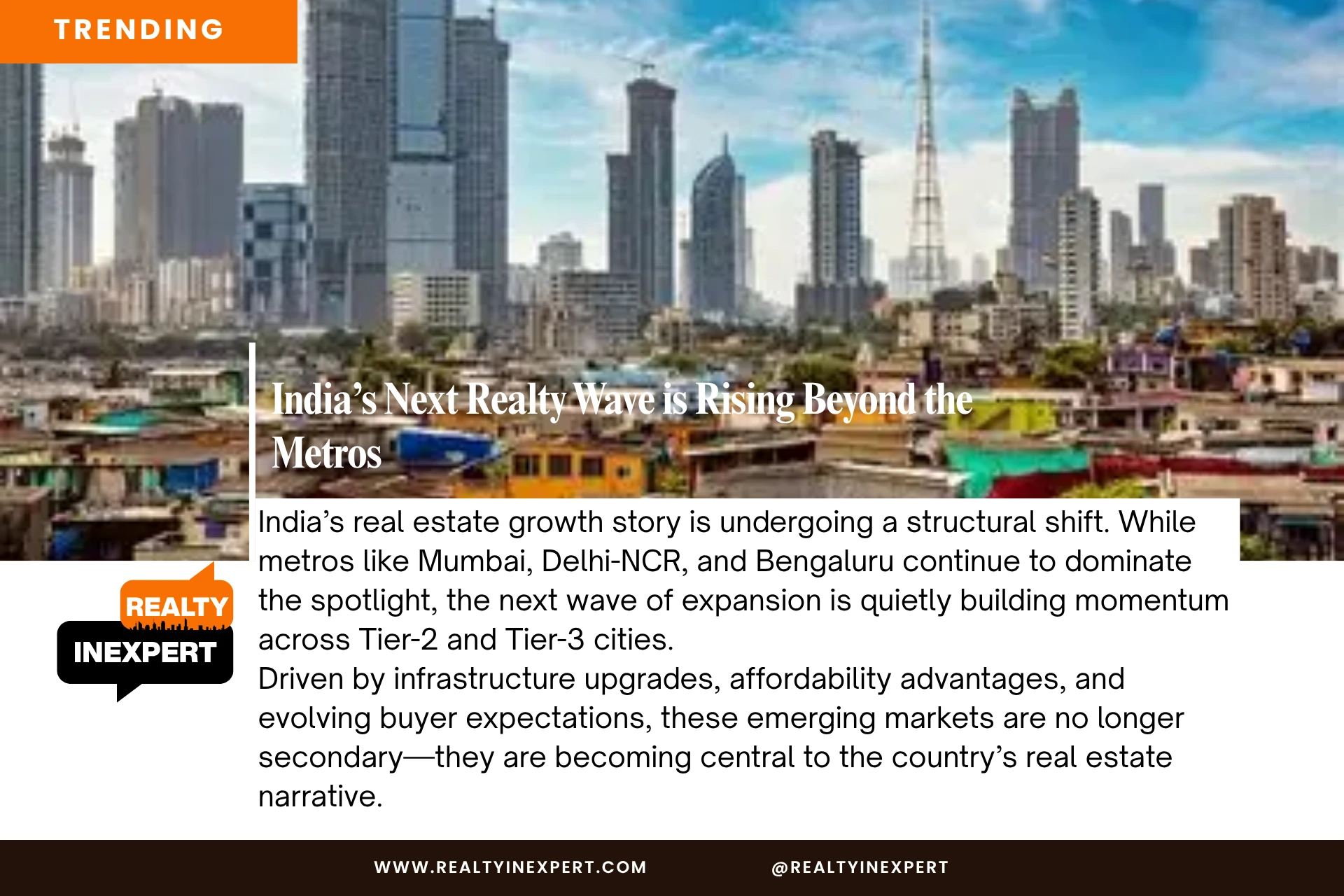
India’s real estate growth story is undergoing a structural shift. While metros like Mumbai, Delhi-NCR, and Bengaluru continue to dominate the spotlight, the next wave of expansion is quietly building momentum across Tier-2 and Tier-3 cities.
Driven by infrastructure upgrades, affordability advantages, and evolving buyer expectations, these emerging markets are no longer secondary—they are becoming central to the country’s real estate narrative.
Growth Expands Beyond Metro Cities
India’s economic activity is becoming more geographically distributed. The rise of industrial corridors, expressways, IT hubs, and educational institutions is creating new growth centres beyond traditional metros.
Cities such as Indore, Jaipur, Lucknow, Surat, and Coimbatore are witnessing consistent traction in both residential and commercial segments. For homebuyers, these cities offer a powerful combination—lower property prices with rapidly improving lifestyle standards.
Developers are responding with:
- Integrated townships
- Plotted developments
- Mixed-use projects
These offerings reflect a clear shift toward planned, modern, and community-driven housing.
Changing Buyer Expectations in Smaller Cities
Today’s homebuyer in Tier-2 and Tier-3 cities is more informed and aspirational than ever before. Factors such as digital exposure, rising incomes, and social mobility have significantly reshaped preferences.
Buyers are no longer driven purely by affordability. Instead, they are prioritizing:
- Smart layouts and modern design
- Quality infrastructure
- Lifestyle amenities
- Developer credibility
This marks a fundamental evolution—from price-sensitive demand to value-driven decision-making.
A Market Driven by Stability, Not Speculation
Unlike the speculative cycles often seen in metro markets, many emerging cities are witnessing end-user-driven demand. This is creating a more stable and sustainable growth environment.
Cities like Lucknow are already showing signs of market maturity, where:
- Buyers are financially disciplined
- Demand is linked to real usage
- Micro-markets are developing around infrastructure corridors
This shift toward stability ensures long-term growth rather than short-term price spikes.
Chandigarh Tricity: A Rising Northern Hub
The Chandigarh Tricity region (Chandigarh, Mohali, Panchkula) is emerging as a key growth hub in North India.
Areas such as:
- New Chandigarh (Mullanpur)
- Aerocity, Mohali
- PR-7 Airport Road corridors
are attracting increasing attention due to:
- Planned urban development
- Strong connectivity to Chandigarh International Airport
- Expanding commercial activity
The region reflects how infrastructure-led growth can transform regional markets into high-potential investment zones.
Infrastructure: The Core Growth Driver
Across India, infrastructure is playing a decisive role in reshaping real estate demand.
Key drivers include:
- Expanding highway networks and expressways
- Improved air connectivity
- Decentralization of business hubs
- Government-led urban development initiatives
As connectivity improves, smaller cities are becoming more accessible, livable, and investment-friendly.
Lower land costs further enable developers to deliver larger, better-planned projects with modern amenities, making these markets increasingly competitive.
A Broader, More Balanced Real Estate Landscape
India’s real estate map is no longer metro-centric. Tier-2 and Tier-3 cities are evolving into independent growth engines, each with distinct demand patterns and long-term potential.
This transformation reflects a deeper shift:
- From concentration to distribution of growth
- From affordability-driven demand to aspiration-led buying
- From speculative cycles to stable, end-user markets


