








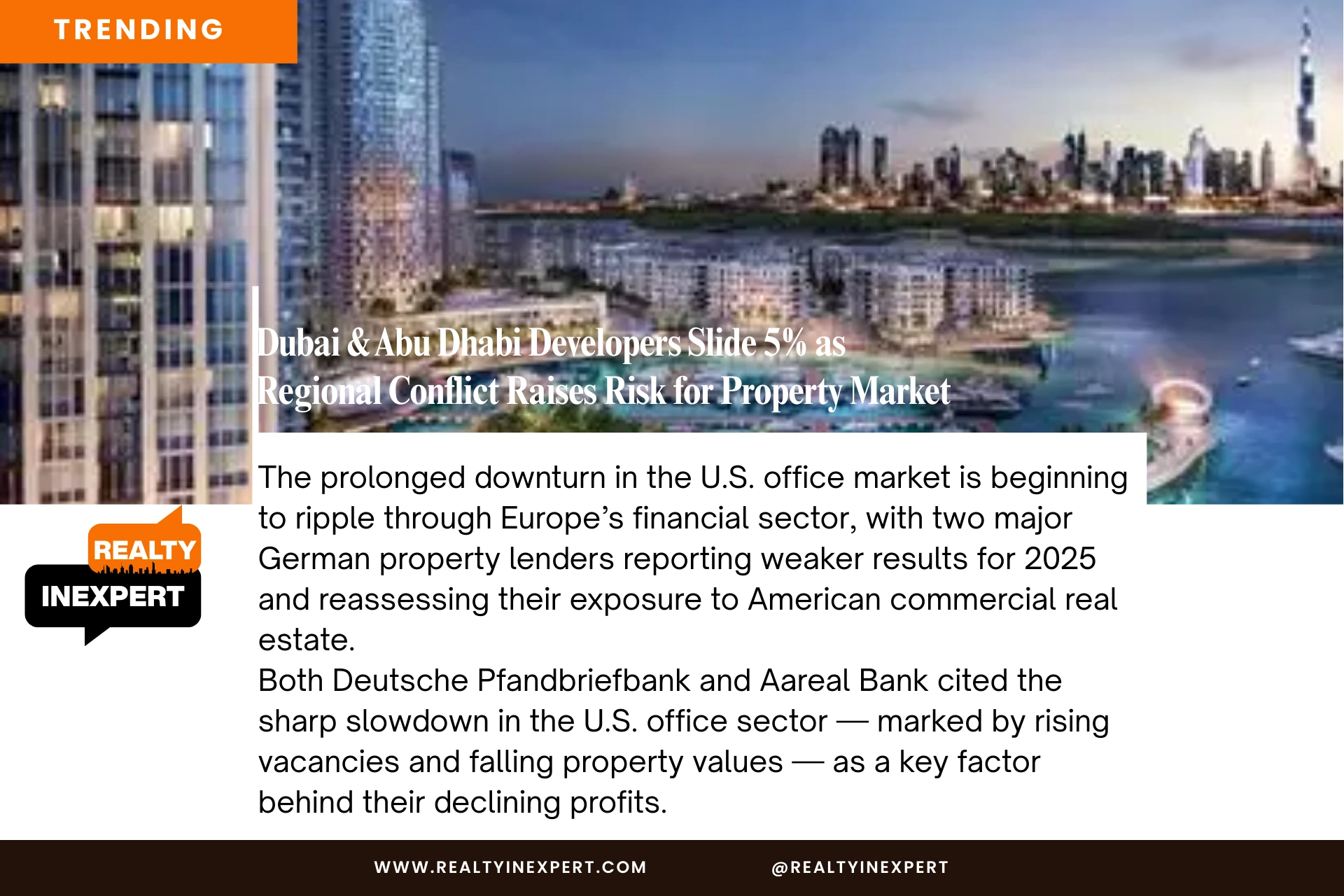
Rising geopolitical tensions are testing the resilience of the UAE’s booming real estate sector, with shares of major developers dropping sharply as investors reassess risks tied to regional instability.
Companies such as Emaar Properties and Aldar Properties saw their shares fall about 5% after recent missile strikes heightened security concerns across the Gulf. The developments have unsettled investors and exposed how heavily property markets in Dubai and Abu Dhabi depend on foreign capital to sustain their rapid growth.
Safe-Haven Reputation Faces Its First Major Test
For years, the UAE has been viewed as a stable investment hub in a volatile region. However, the recent attacks on airports, ports and residential areas in both cities have dented that perception at a time when concerns about overheating in the property market were already emerging.
The impact was quickly reflected in financial markets. Alongside falling share prices for major developers, bond prices of several UAE property companies also declined. Bond markets — a crucial funding channel for developers — have effectively closed for new issuance, with borrowing spreads widening across the sector.
The uncertainty is particularly concerning because off-plan sales dominate the market. According to property brokerage Betterhomes, off-plan deals accounted for about 65% of property transactions in Dubai in 2025, meaning most buyers were purchasing homes still under construction.
If investor confidence weakens, that pipeline of future projects could face significant pressure.
Developers Urge Calm Despite Market Reaction
Some developers have played down the selloff, pointing to the region’s economic fundamentals.
Ziad El Chaar, CEO of luxury developer Dar Global, said market sentiment could stabilise quickly.
“In this region we know things start quickly and end quickly and we overcome this because the fundamentals across the GCC nations are strong,” he said, adding that projects currently under development remain on schedule.
However, others in the industry say the effects are already becoming visible. A senior real estate banker told Reuters his firm has shelved a planned capital-raising for a UAE property project this week as investor appetite weakened.
He added that international lenders could face pressure to reduce exposure to new property loans, which might eventually force developers to consider asset sales if the conflict drags on.
A Real Estate Boom Built on Global Capital
The current uncertainty comes after a remarkable real estate rally that reshaped the UAE skyline over the past two decades.
In Dubai, landmark projects such as Palm Jumeirah have become globally recognised luxury enclaves, while construction has resumed on the massive Palm Jebel Ali development.
Meanwhile, Abu Dhabi has been steadily transforming its coastline through large-scale residential and mixed-use projects.
The post-pandemic period accelerated the rally. The UAE’s tax-free environment, relaxed visa rules and economic reforms attracted wealthy migrants, entrepreneurs and global investors.
Capital inflows surged after the Russian invasion of Ukraine, as Russians, international family offices and hedge funds increasingly turned to UAE real estate.
By 2025, the country’s population had exceeded 11 million, with expatriates making up nearly 90% of residents, one of the highest proportions globally.
Property Prices Surged in Recent Years
The influx of global capital drove rapid price growth.
According to ratings agency Fitch Ratings, Dubai residential property prices rose about 60% between 2022 and the first quarter of 2025.
Growth continued into late 2025, with residential prices rising nearly 13% year-on-year in the fourth quarter, according to property consultancy CBRE Group.
In Abu Dhabi, residential property prices climbed even faster, increasing almost 32% over the same period.
Mohammed Ali Yasin, CEO of Ghaf Benefits, said the real impact of the conflict would depend on whether demand returns once tensions ease.
“The real effect on real estate should be measured on the level of demand once the conflict halts,” he said.
Supply Surge Was Already Raising Concerns
Even before the geopolitical tensions, analysts had begun warning that the UAE property market might be approaching a supply imbalance.
Economists at JPMorgan Chase recently projected that Dubai could see 300,000 to 400,000 new housing units delivered by 2028, potentially outpacing population growth.
Meanwhile, analysts at Abu Dhabi Commercial Bank highlighted that foreign buyers remain a critical demand pillar for the market.
They warned that with new housing supply expected to rise from the second half of this year, investor sentiment will play a decisive role in determining whether the market absorbs the upcoming inventory.
Stability Remains Key for Property Investment
Real estate markets typically rely heavily on long-term visibility, investor confidence and macroeconomic stability. Prolonged geopolitical uncertainty can weaken all three.
Ryan Lemand, co-founder and CEO of Neovision Wealth Management, noted that property markets are particularly sensitive to geopolitical risk.
“Real estate investment typically relies on stability, visibility and sustained investor confidence — all of which tend to weaken during prolonged geopolitical uncertainty,” he said.
For now, the UAE property market remains one of the world’s most dynamic. But the latest tensions highlight how quickly external shocks can test even the most resilient real estate booms.


