








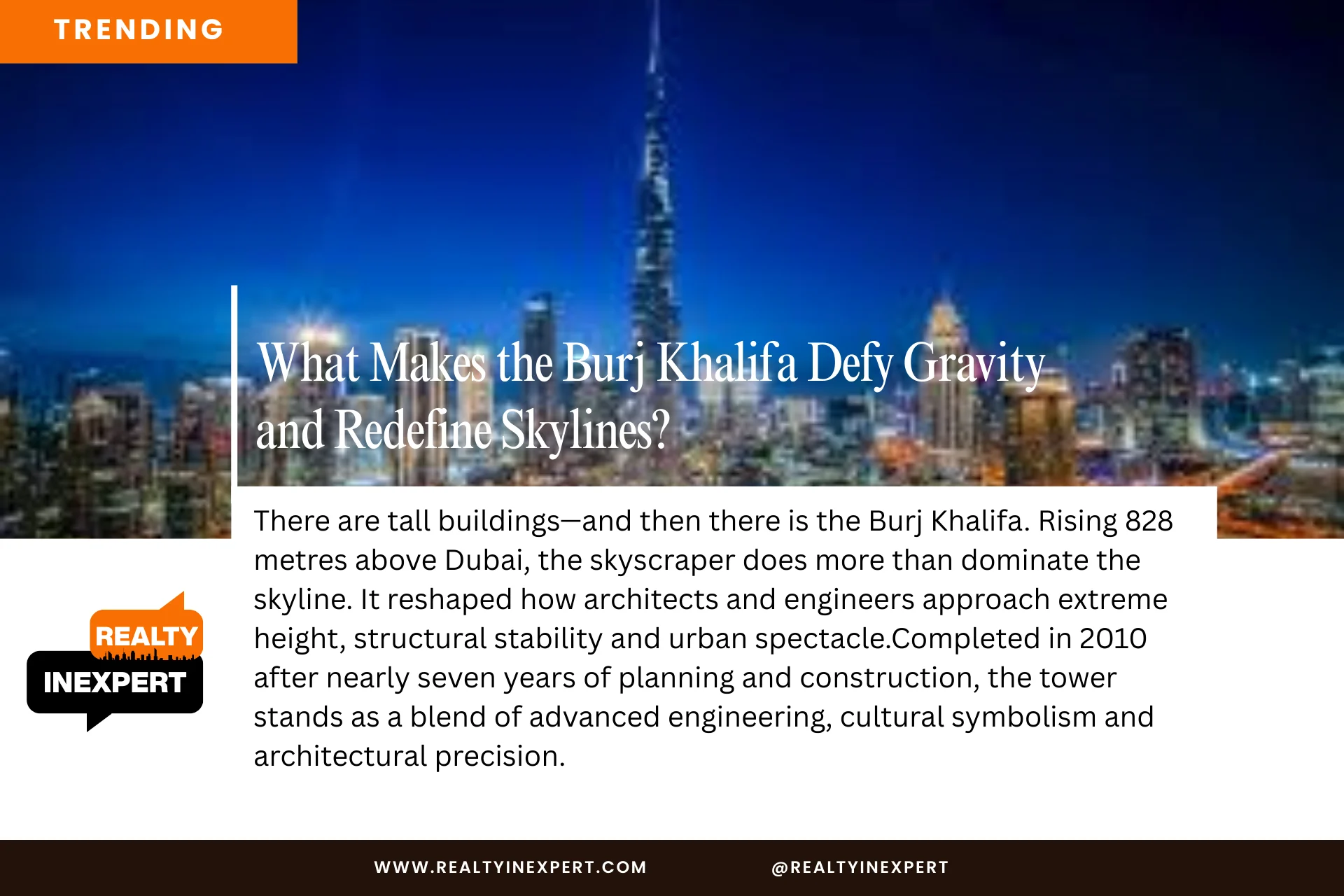
There are tall buildings—and then there is the Burj Khalifa. Rising 828 metres above Dubai, the skyscraper does more than dominate the skyline. It reshaped how architects and engineers approach extreme height, structural stability and urban spectacle.
Completed in 2010 after nearly seven years of planning and construction, the tower stands as a blend of advanced engineering, cultural symbolism and architectural precision. Developed by Emaar Properties, the building remains the tallest structure ever built and a global benchmark for skyscraper design.
Here is a closer look at the architectural and engineering ideas that make the Burj Khalifa extraordinary.
A Flower-Inspired Foundation
At first glance, the tower appears sleek and futuristic. But its structural concept begins with something organic.
The base of the building is inspired by the desert flower Hymenocallis, also known as the spider lily. The floor plan forms a Y-shaped structure, where three wings radiate from a central core.
This design is not simply aesthetic. The three wings support each other structurally, helping distribute the immense weight of the building while improving resistance to strong winds. The shape also maximises natural light and provides sweeping views of the Arabian Gulf for most apartments and offices.
As the tower rises, the wings step back at varying heights. These setbacks disrupt wind flow, reducing a phenomenon known as vortex shedding. By breaking the wind’s rhythm, the building remains stable even at extreme heights.
Engineering Built for the Sky
Constructing the world’s tallest tower meant treating wind as one of the most important design challenges.
Engineers conducted more than 40 wind-tunnel tests to understand how air currents would interact with the structure. Even the construction cranes were tested to ensure they could operate safely hundreds of metres above ground.
The foundation itself is massive. Construction began in January 2004, with the tower supported by a reinforced concrete raft foundation and deep steel-reinforced piles.
Key construction figures highlight the scale of the project:
330,000 cubic metres of concrete
39,000 tonnes of steel
A façade reaching 512 metres high
The aluminium used in the façade weighs roughly the same as five Airbus A380 aircraft, demonstrating the enormous scale of materials required to create such stability.
The Iconic Spire
As the tower narrows toward the top, its central core extends into a sleek spire.
The spire is not merely decorative. It contributes significantly to the building’s record-breaking height and houses communication equipment. Structurally, it is a steel-framed extension that continues the tower’s upward thrust.
The result is the slender, needle-like silhouette that has become one of the most recognisable architectural icons in the world.
A Blend of Modern Engineering and Cultural Design
Despite its futuristic appearance, the tower draws inspiration from regional architectural traditions.
The geometry reflects repetition and symmetry often seen in Islamic architecture, while the tapering vertical form recalls traditional minarets found across the Middle East.
The façade uses a combination of reflective glass, aluminium and textured stainless steel. During the day, it mirrors the desert sky and surrounding cityscape. At night, advanced lighting systems transform the building into a luminous landmark.
The tower was designed by architect Adrian Smith while working at Skidmore, Owings & Merrill, with structural engineering led by William F. Baker.
A Vertical City
The Burj Khalifa is far more than an observation tower—it functions as a vertical mixed-use city.
The building houses:
The luxury Armani Hotel Dubai
Private Armani Residences
Luxury apartments
Premium corporate office suites
Restaurants, lounges and retail spaces
One of its most famous venues is At.mosphere, a fine-dining restaurant located on Level 122, offering panoramic views of the city.
Observation decks on Levels 124 and 148 attract millions of visitors each year, providing sweeping views across Dubai’s coastline and desert landscape.
Sky lobbies on Levels 43, 76 and 123 include swimming pools, fitness centres and recreational spaces for residents.
High-Speed Elevators and the Stack Effect
Moving people through a building nearly 800 metres tall required a highly advanced elevator system.
The tower’s elevators hold records for vertical travel distance and are designed to manage pressure changes experienced at extreme heights.
Engineers also studied the stack effect, sometimes called the chimney effect. In tall buildings, differences in air pressure between lower and upper floors can create powerful airflow through shafts and stairwells.
Careful airflow management ensures comfort, safety and energy efficiency for occupants.
A Landmark Setting
The Burj Khalifa is surrounded by landscaped gardens and an artificial lake that houses the famous Dubai Fountain.
Daily fountain shows combine water, music and lighting, creating one of the city’s most popular attractions.
On New Year’s Eve, the tower becomes the centrepiece of massive fireworks and light displays that draw global attention.
From Burj Dubai to Burj Khalifa
The project faced challenges during the 2008 global financial crisis, which threatened construction progress. Financial assistance from Abu Dhabi helped ensure completion.
In recognition of this support, the tower was renamed Burj Khalifa in honour of Khalifa bin Zayed Al Nahyan.
It officially opened on January 4, 2010, and was later recognised by the Council on Tall Buildings and Urban Habitat as the world’s tallest building.
More Than Just Height
The Burj Khalifa’s true achievement lies not only in its height but in its architectural clarity.
Every element—from the Y-shaped base to the stepped setbacks and the soaring spire—serves a structural purpose while shaping its elegant form.
By combining engineering innovation, cultural inspiration and urban design, the tower has redefined what modern skyscrapers can achieve.


