



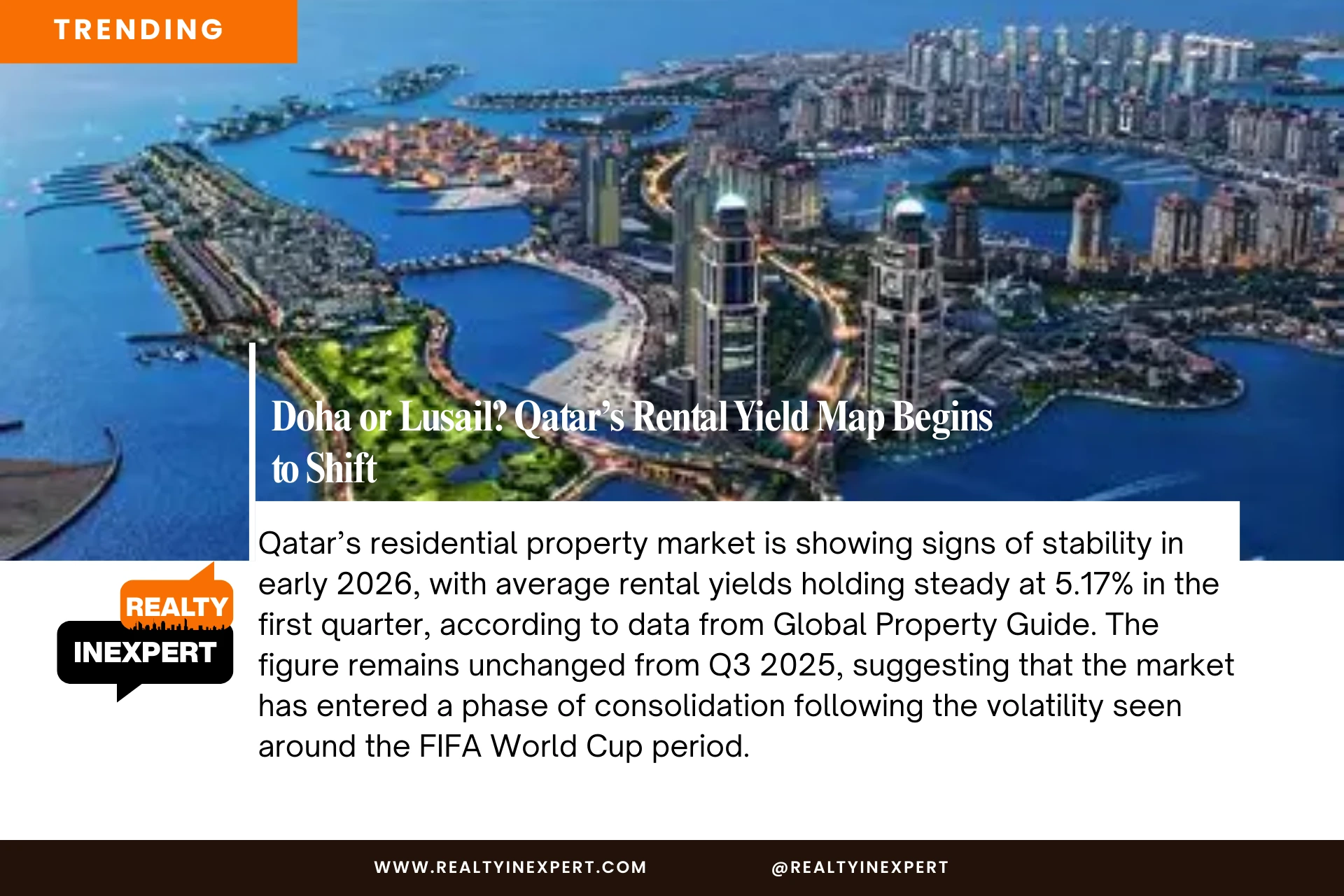
Qatar’s residential property market is showing signs of stability in early 2026, with average rental yields holding steady at 5.17% in the first quarter, according to data from Global Property Guide. The figure remains unchanged from Q3 2025, suggesting that the market has entered a phase of consolidation following the volatility seen around the FIFA World Cup period.
However, while the national average appears stable, significant variations are emerging between key residential hubs, particularly Doha, the country’s capital, and Lusail, the rapidly developing planned city north of Doha.
For investors evaluating opportunities in Qatar’s property market, these differences highlight a shift in rental income potential between mature urban centres and newly developed districts.
Lusail Emerging as a Higher-Yield Market
Among Qatar’s major residential markets, Lusail currently offers stronger rental returns than Doha. Average rental yields in Lusail stand at 5.65%, compared with 4.68% in Doha.
This trend reflects a broader pattern observed in global real estate markets, where newly planned cities often deliver stronger rental yields during their early development phase.
Lusail, a modern waterfront city built north of Doha, has been one of Qatar’s most ambitious urban developments in recent years. With high-rise residential towers, entertainment districts, waterfront promenades and modern infrastructure, the city has quickly emerged as a key residential and investment destination.
Rental data shows that smaller apartments in Lusail generate particularly attractive returns.
Studio apartments: ~6.33% rental yield
One-bedroom apartments: ~6.24% yield
Two-bedroom apartments: close to 6% yield
However, yields begin to decline as property sizes increase. Three-bedroom units in Lusail deliver around 4.07%, illustrating the typical global trend where larger homes generate lower yields relative to their purchase price.
Doha’s Rental Market Shows Mixed Performance
In contrast, Doha’s residential market presents a more varied rental yield picture. As the country’s largest and most established property market, average yields in the capital currently stand at around 4.68%.
Within Doha, rental performance varies significantly depending on location, property type and apartment size.
One of the city’s most prominent residential districts, The Pearl, continues to attract premium buyers and tenants. In this luxury waterfront community, studio apartments generate yields of around 6.50%, among the highest in Doha.
However, yields decline gradually as apartment sizes increase:
One-bedroom apartments: ~5.89%
Three-bedroom apartments: ~5.37%
Four-bedroom and larger units: ~5.28%
Outside The Pearl, returns vary even more widely. In certain residential pockets, two-bedroom apartments can generate yields exceeding 7%, indicating strong demand in specific micro-markets.
At the same time, larger family homes across the broader Doha market tend to produce lower income returns. Average yields for three-bedroom apartments across the city fall to around 3.54%, reflecting the higher purchase prices of larger residential units.
What the Yield Numbers Mean for Investors
Gross rental yield is a key metric used by property investors to estimate potential returns from residential real estate. It compares the annual rental income of a property with its purchase price.
However, the figures reported represent gross yields, which do not include expenses such as property management fees, maintenance costs, brokerage charges or taxes.
Once these costs are factored in, net rental yields typically fall by around 1.5% to 2%, according to Global Property Guide.
Despite this adjustment, Qatar’s rental returns remain competitive compared with many established global property markets, especially in cities where property prices have surged significantly over the past decade.
Stability After a Period of Market Adjustment
The fact that Qatar’s national rental yield has remained unchanged at 5.17% since Q3 2025 suggests that the residential market is entering a period of relative balance.
After the rapid construction boom leading up to the 2022 FIFA World Cup, Qatar’s real estate sector experienced phases of supply expansion and rental adjustments. Now, the market appears to be stabilising as housing supply and tenant demand begin to align more closely.
For investors, this stability may signal a more predictable rental environment, even as newer districts such as Lusail continue to reshape the country’s property landscape.
As infrastructure development and urban expansion continue, the contrast between established markets like Doha and emerging areas like Lusail is likely to become one of the defining trends in Qatar’s real estate sector over the coming years.
