


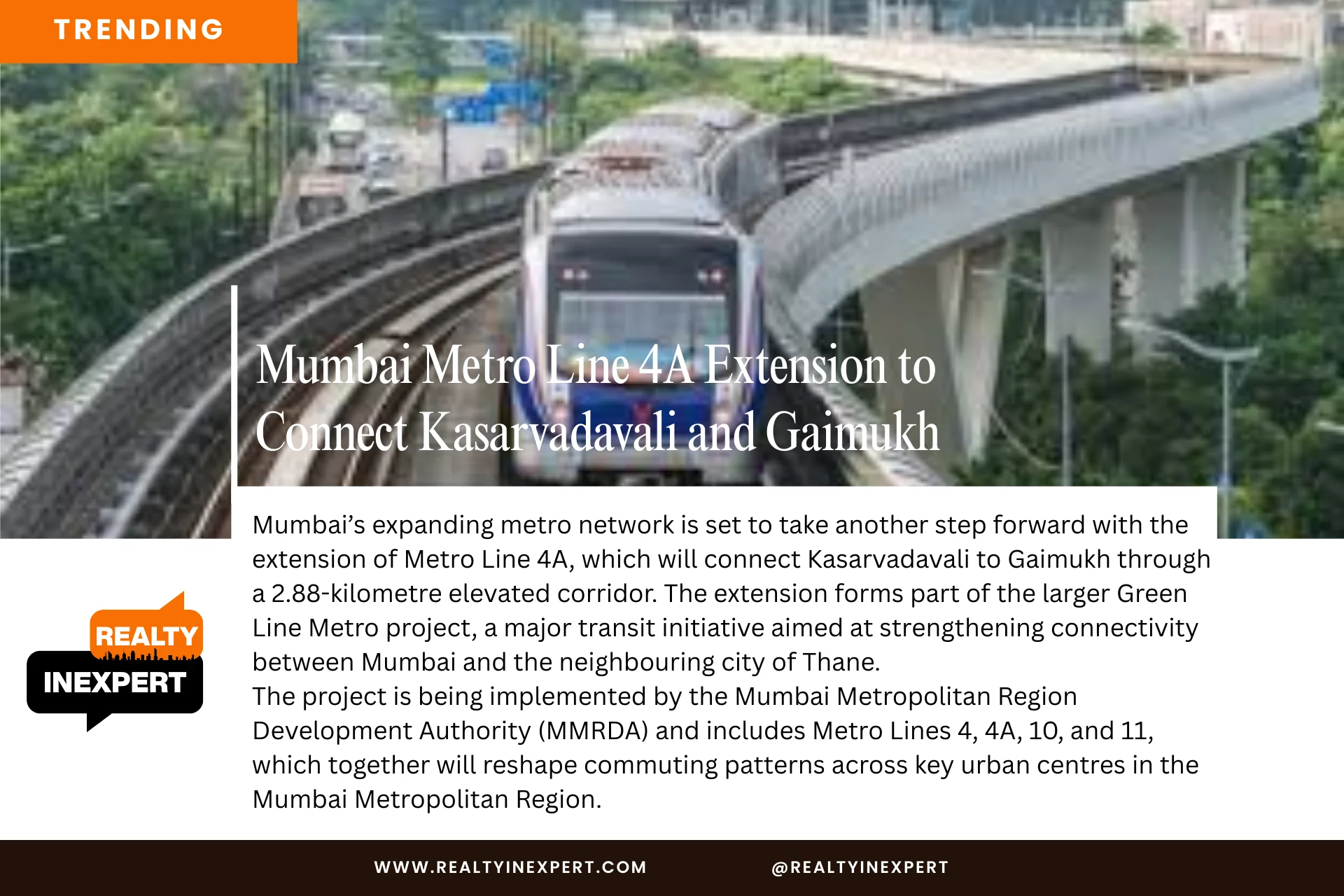
Mumbai’s expanding metro network is set to take another step forward with the extension of Metro Line 4A, which will connect Kasarvadavali to Gaimukh through a 2.88-kilometre elevated corridor. The extension forms part of the larger Green Line Metro project, a major transit initiative aimed at strengthening connectivity between Mumbai and the neighbouring city of Thane.
The project is being implemented by the Mumbai Metropolitan Region Development Authority (MMRDA) and includes Metro Lines 4, 4A, 10, and 11, which together will reshape commuting patterns across key urban centres in the Mumbai Metropolitan Region.
A Major Metro Corridor for Mumbai and Thane
The Green Line Metro corridor will span approximately 57.18 kilometres, connecting several important nodes across the metropolitan region. Key locations along the network include Wadala, Kasarvadavali, Gaimukh, Mira Road, and Chhatrapati Shivaji Terminus.
The largely elevated network will feature 48 metro stations and aims to reduce travel time significantly while improving access to residential, commercial and educational hubs across the region.
The Maharashtra government approved Metro Line 4 in 2016, and the project’s foundation stone was laid the same year by Narendra Modi, marking the beginning of one of Mumbai’s major urban mobility upgrades.
Project Structure and Construction Packages
The Green Line project is being executed under the Engineering, Procurement and Construction (EPC) model and divided into multiple packages.
Three major construction packages, worth about ₹1,584 crore, were awarded to a joint venture between Reliance Infrastructure and Astaldi S.p.A.. This section covers roughly 32.32 kilometres along LBS Marg and the Eastern Express Highway, linking Wadala to Kasarvadavali.
The remaining two packages, valued at approximately ₹1,048 crore, were awarded to a consortium led by Tata Projects Limited along with China Harbour Engineering Company.
The overall objective of the project is to reduce traffic congestion and provide a faster and more reliable public transport option for daily commuters.
Route Details of the Green Line
The Green Line Metro network is divided into four main segments:
Metro Line 4: Wadala to Kasarvadavali
Metro Line 4A: Kasarvadavali to Gaimukh
Metro Line 10: Gaimukh to Shivaji Chowk in Mira Road
Metro Line 11: Bandra Terminus to SPM Chowk
The 32-kilometre Metro Line 4 corridor will connect eastern and western parts of the city with multiple interchanges. Important interchanges include Kapurbawdi (Metro Line 5) and Gandhi Nagar (Metro Line 6).
Meanwhile, Metro Line 4A, the current extension under development, will stretch 2.88 kilometres from Kasarvadavali to Gaimukh and will include elevated stations at Gowniwada and Gaimukh. The line will also feature a 20-hectare metro depot at Mogharpada.
Combined, Metro Lines 4 and 4A will create a 35.25-kilometre corridor with 32 stations and five interchanges, making it one of the longest metro corridors in the Mumbai Metropolitan Region.
Construction Progress and Timeline
Trial runs are currently underway on a 10.5-kilometre stretch between Cadbury Junction and Gaimukh. Approvals from the Commissioner of Metro Rail Safety are expected soon.
Officials aim to open this section for passengers by December 2025, while the full Metro Line 4 corridor is targeted for completion by August 2026.
Another key component, Metro Line 10, will extend 9.2 kilometres from Gaimukh to Shivaji Chowk and run parallel to the Thane–Bhayandar highway. This section is expected to significantly reduce travel time between Mira-Bhayander, Thane, Borivali and Mumbai.
Underground Metro Line 11
Metro Line 11 is planned as a 23.4-kilometre underground corridor connecting Bandra Terminus to SPM Chowk near the Gateway of India.
The line will include interchanges with other major metro routes, including Metro Line 3 and Metro Line 4, and is expected to support large urban redevelopment projects such as the Dharavi redevelopment initiative.
By 2031, the line is projected to handle around six lakh passengers daily.
Advanced tunnelling technologies such as Tunnel Boring Machines (TBMs) and the New Austrian Tunnelling Method (NATM) are being used to protect heritage structures and minimise disruption during construction.
Modern Facilities for Metro Commuters
The Green Line Metro will feature modern transit infrastructure designed to enhance commuter comfort and efficiency.
Key features include:
Maximum train speed of 80 km/h
Average operational speed of 34 km/h
Standard gauge tracks (1435 mm) powered by 25 kV AC electrification
Communication-Based Train Control (CBTC) signalling system
Automatic fare collection through NFC cards and QR codes
Stations will also include amenities such as escalators, elevators, ramps, first-aid facilities, washrooms, water coolers, passenger information displays and retail outlets.
Impact on Real Estate and Local Infrastructure
Improved metro connectivity is expected to significantly influence real estate activity along the corridor. Areas such as **Mulund, Thane, and Kasarvadavali are likely to see stronger residential and commercial demand.
Residential developments along the corridor currently offer property prices ranging between ₹7,500 and ₹11,700 per sq ft, and improved accessibility could further boost property values and business activity in the region.
Commercial hubs in Mulund and nearby areas are also expected to benefit from increased footfall once the metro becomes operational.
Transforming Urban Mobility in Mumbai
The Green Line Metro represents more than just an infrastructure project. By improving connectivity between Mumbai and the Thane region, the network aims to reduce road congestion, improve travel efficiency and support sustainable urban development.
With faster travel, modern facilities and improved interconnectivity, the metro expansion is expected to play a key role in shaping the future of public transportation and real estate growth in the Mumbai Metropolitan Region.
