



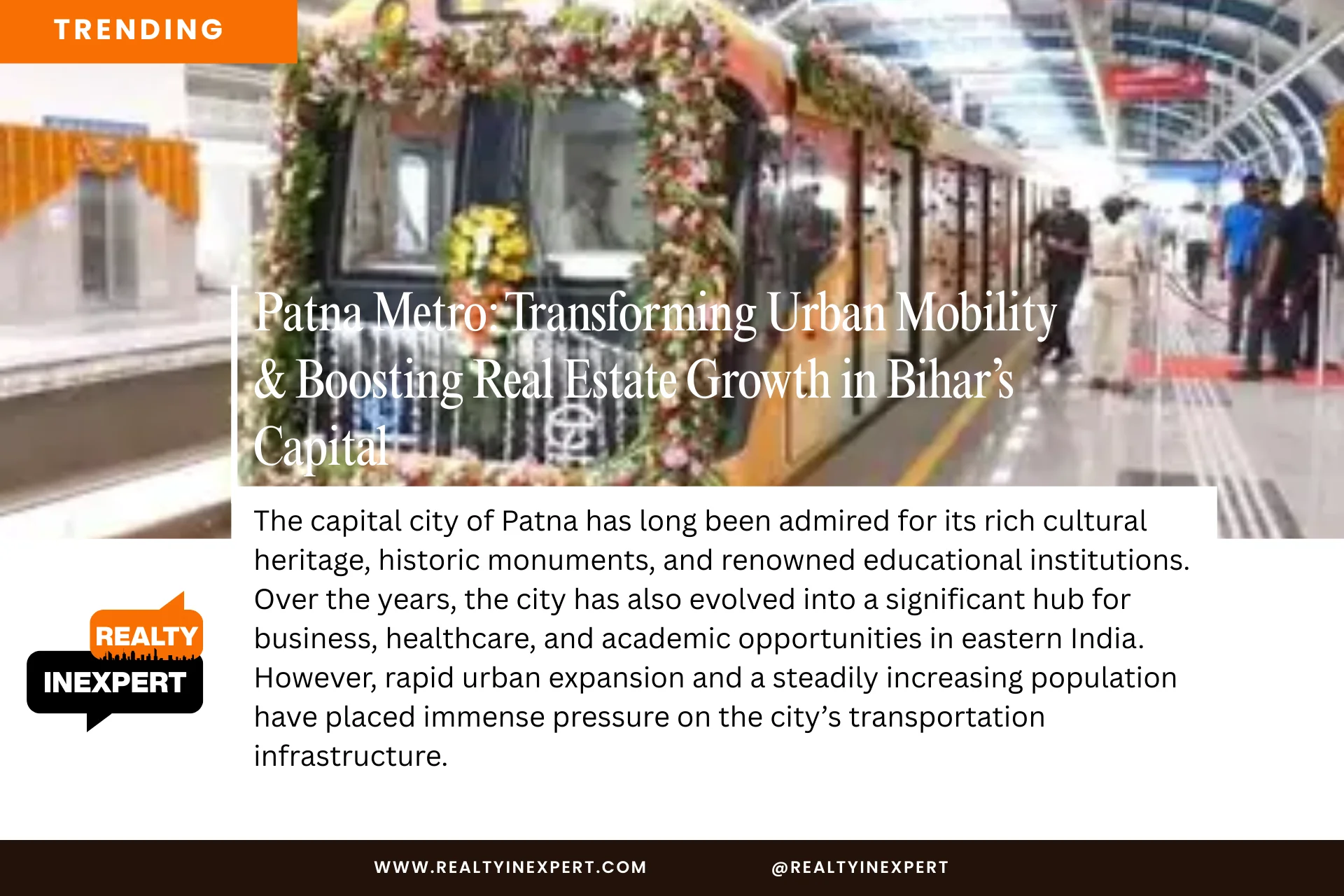
The capital city of Patna has long been admired for its rich cultural heritage, historic monuments, and renowned educational institutions. Over the years, the city has also evolved into a significant hub for business, healthcare, and academic opportunities in eastern India. However, rapid urban expansion and a steadily increasing population have placed immense pressure on the city’s transportation infrastructure.
To address congestion, pollution, and mobility challenges, the government introduced the ambitious Patna Metro project. Once completed, the metro network is expected to transform Patna’s urban mobility landscape by offering a modern, efficient, and environmentally friendly public transport system. In addition to improving daily commuting, the metro is also anticipated to trigger significant growth in the city’s real estate sector.
Overview of the Patna Metro Project
The metro system is owned and operated by the Patna Metro Rail Corporation (PMRC) and is being developed through a Public-Private Partnership (PPP) model. The project has an estimated cost of around ₹13,365 crore and will be executed in multiple phases.
During its initial phase, the metro network will consist of two major corridors designed to connect key residential, commercial, and institutional areas of the city.
East–West Corridor (Line 1 – Red Line)
North–South Corridor (Line 2 – Blue Line)
Together, the network will include approximately 23.30 kilometres of elevated tracks and about 16.30 kilometres of underground sections. Trains are expected to operate at speeds of up to 80 km/h, significantly reducing travel time across the city.
The first operational stretch of the network will run between Malahi Pakri and Bairia, improving connectivity to important transport hubs and densely populated areas.
Line 1 – Red Line (East–West Corridor)
The Red Line will connect Danapur Cantonment to Khemni Chak, covering a distance of about 16.86 kilometres. The corridor will consist of both elevated and underground sections.
Key highlights:
Total length: 16.86 km
Elevated section: 9.36 km
Underground section: 7.5 km
Total stations: 14
Elevated Stations
Danapur Cantonment
Saguna More
RPS More
Mithapur
Ramkrishna Nagar
Jaganpur
Khemni Chak
Underground Stations
Patliputra
Rukanpura
Raja Bazar
Patna Zoo
Vikas Bhawan
Vidyut Bhawan
Patna Junction
All stations on this corridor are expected to become fully operational by 2027, making east–west travel within the city faster and more convenient.
Line 2 – Blue Line (North–South Corridor)
The Blue Line stretches about 14.06 kilometres and includes both elevated and underground sections.
Key highlights:
Elevated section: ~6 km
Underground section: ~8 km
Total stations: 12
Underground Stations
Patna Junction
Akashvani
Gandhi Maidan
PMCH
Patna University
Moin Ul Haq Stadium
Rajendra Nagar
Elevated Stations
Malahi Pakadi
Khemni Chak
Bhoothnath
Zero Mile
New ISBT
A portion of this corridor became operational in October 2025, with three functional stations:
New Patliputra Bus Terminal (New ISBT)
Zero Mile
Bhoothnath
The remaining sections of the corridor are expected to become fully operational by 2030.
Interchange Stations and Connectivity
To ensure smooth transfers between the two metro corridors, interchange facilities will be available at:
Patna Junction
Khemni Chak
These stations are strategically integrated with major transportation hubs such as railway terminals and bus stations. This multimodal integration will allow commuters to easily shift between metro trains, buses, and long-distance rail services.
For instance, passengers traveling on the Red Line will be able to switch to the Blue Line at Patna Junction to reach key destinations such as Gandhi Maidan, PMCH, and Patna University.
Recent Developments and Upcoming Expansion
The Patna Metro network is steadily expanding with the Malahi Pakadi stretch nearing completion. As of February 2026, several major milestones have been achieved:
Safety approvals granted for overhead power systems and traction lines
Fire safety inspections nearing completion
Final station finishing and infrastructure work underway
Once operational, the new section will extend the running corridor from New ISBT to Malahi Pakadi, increasing the operational network to five stations and covering approximately 6.1 kilometres.
The expected fare for this stretch is around ₹30.
However, trains will temporarily pass through Khemni Chak without stopping due to pending land acquisition issues. Authorities expect this stretch to open for public use in March 2026.
Impact on Patna’s Real Estate Market
Major metro projects often reshape urban development patterns, and the Patna Metro is likely to have a similar impact. Improved connectivity typically leads to:
Higher property demand near metro stations
Growth of commercial hubs along metro corridors
Increased rental demand in well-connected areas
Expansion of residential developments in suburban zones
Areas such as Danapur, Saguna More, Khemni Chak, and Mithapur are already witnessing growing interest from developers and homebuyers due to improved future connectivity.
For investors and homebuyers alike, metro-linked locations often offer long-term appreciation potential, making the Patna Metro a significant catalyst for the city’s real estate growth.
The Road Ahead
Once fully operational, the Patna Metro will not only reduce congestion and pollution but also provide a reliable mass transit option for millions of residents. With better connectivity across the city, improved access to educational institutions, hospitals, and commercial centres will further enhance Patna’s livability.
More importantly, the metro project is expected to unlock new real estate corridors and encourage planned urban development, positioning Patna as one of the emerging growth centres in eastern India.
