



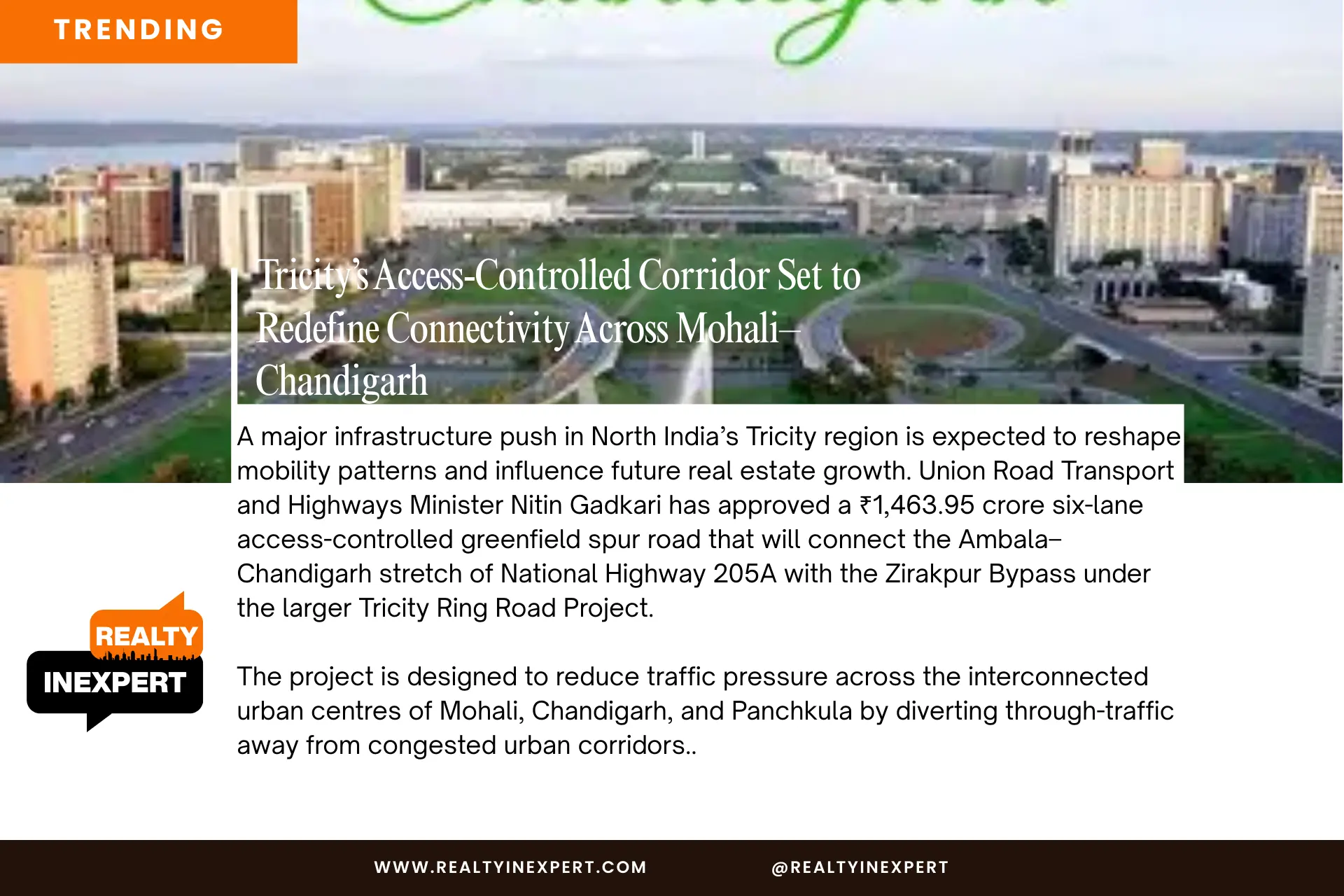
A major infrastructure push in North India’s Tricity region is expected to reshape mobility patterns and influence future real estate growth. Union Road Transport and Highways Minister Nitin Gadkari has approved a ₹1,463.95 crore six-lane access-controlled greenfield spur road that will connect the Ambala–Chandigarh stretch of National Highway 205A with the Zirakpur Bypass under the larger Tricity Ring Road Project.
The project is designed to reduce traffic pressure across the interconnected urban centres of Mohali, Chandigarh, and Panchkula by diverting through-traffic away from congested urban corridors.
Beyond easing congestion, the new road is expected to improve travel efficiency across the Tricity region and strengthen connectivity toward Shimla and the wider Himachal Pradesh region. Urban planning experts believe access-controlled corridors often play a pivotal role in redefining land value patterns and shaping long-term development trajectories.
Infrastructure That Changes Mobility Patterns
Infrastructure upgrades often have a deeper impact than simply reducing travel time. Access-controlled highways can fundamentally reshape how people move, where they choose to live, and how cities expand.
With controlled entry and exit points, such corridors create predictable commute times, a factor that is increasingly influencing residential preferences across the Mohali–Chandigarh–Panchkula belt.
Urban planners say improved connectivity:
Encourages residential development in peripheral sectors
Reduces traffic pressure in city centres
Improves overall urban liveability
Supports institutional-grade real estate development
Reduced through-traffic can also improve neighbourhood environments by lowering congestion and transit stress within city cores.
Over time, such projects signal a broader shift in urban growth patterns—from organic outward expansion to infrastructure-led planning.
Early Developers May Benefit From Corridor Influence
Developers who already have projects located along the influence zones of upcoming infrastructure corridors often benefit from early positioning.
One such developer is Royale Estate Group, which has multiple developments located near the emerging connectivity corridor.
These include:
Chandigarh Royale City on Chandigarh–Patiala Road
1 Royale Park on Zirakpur–Patiala Road, Mohali
Mohali Industrial Economic Zone (MIEZ) at SAS Nagar, Mohali
Industry observers note that when large-scale transport infrastructure becomes operational, projects previously viewed as peripheral often become strategically integrated urban nodes.
This transformation typically supports both residential and industrial ecosystems.
Connectivity Driving Long-Term Real Estate Stability
Commenting on the infrastructure development, Piyush Kansal, Executive Director at Royale Estate Group, highlighted the wider economic implications.
“Mobility infrastructure of this scale changes how regions function. When corridors become access-controlled and future-ready, they don’t just ease traffic; they strengthen economic continuity between cities.
In the Mohali–Chandigarh growth belt, we are already seeing how better connectivity improves workforce movement, logistics efficiency and end-user confidence. Such interventions create stability in urban expansion. Over time, well-connected micro-markets evolve into structured growth zones rather than speculative pockets.”
Industry analysts say access-controlled transport networks also tend to encourage structured, compliant development patterns, reducing fragmented and unplanned expansion.
Wider Impact on the Tricity Real Estate Market
Historically, land parcels located near major mobility corridors tend to experience steady and calibrated price appreciation rather than speculative spikes.
Improved connectivity enhances the credibility of emerging micro-markets and often attracts industrial investments, logistics hubs, and institutional projects.
Key expected impacts include:
Increased demand for residential housing near the corridor
Growth of industrial and logistics hubs
Improved workforce mobility between cities
Strengthening of economic integration across the region
At the same time, homebuyers today are increasingly prioritising commute predictability and connectivity over proximity alone.
Infrastructure-Led Urban Expansion
As the Tricity region continues to expand, its development pattern appears to be evolving from reactive demand-led growth to infrastructure-driven planning.
Strategic transport corridors are gradually redefining value maps across the Mohali–Chandigarh region, determining which micro-markets integrate into the urban core and which remain on the periphery.
Developers who align projects with long-term infrastructure frameworks often create more resilient real estate assets anchored in connectivity and long-term planning.
In that context, the proposed six-lane spur road may do more than simply decongest highways—it could reshape the development geometry of Mohali and neighbouring urban belts.
As mobility networks mature, urban growth increasingly follows infrastructure intent rather than speculative impulse, setting the stage for the next phase of Tricity’s evolution.
